Piche Resources (PR2:AU) has announced $2million placement to advance Argentine exploration
Download the PDF here.
This post appeared first on investingnews.com



Piche Resources (PR2:AU) has announced $2million placement to advance Argentine exploration
Download the PDF here.

Nevada Sunrise Metals Corporation (TSXV: NEV,OTC:NVSGF) (OTC Pink: NVSGF) (‘Nevada Sunrise’ or the ‘Company’) is pleased to announce it has closed a non-brokered private placement (the ‘Offering’) for gross proceeds of $650,000, consisting of 13,000,000 units (the ‘Units’) at a price of $0.05 per Unit, with each Unit comprised of one common share of the Company and one common share purchase warrant (a ‘Warrant’). Each Warrant will entitle the holder to purchase one common share at a price of $0.075 for a period expiring three years from the closing date of the Offering. Due to investor demand, the Offering was increased from $600,000 (12,000,000 Units) (see news release dated October 16, 2025) to $650,000 (13,000,000 Units).
Proceeds of the Offering will be used for:
The Offering was available to accredited investors and individuals that qualified under certain other statutory exemptions. The securities issued pursuant to the Offering are subject to a statutory hold period expiring March 7, 2026. In connection with the closing of the Offering, the Company paid finder’s fees consisting of a total of $31,500 cash and 630,000 finder’s warrants (each a ‘Finder’s Warrant‘) to Canaccord Genuity Corp. Each Finder’s Warrant is exercisable at a price of $0.075 for a period of three years from the closing date of the Offering. The Offering is subject to acceptance of the TSX Venture Exchange.
This news release does not constitute an offer of sale of any of the foregoing securities in the United States. None of the foregoing securities have been and will not be registered under the U.S. Securities Act of 1933, as amended (the ‘1933 Act‘) or any applicable state securities laws and may not be offered or sold in the United States or to, or for the account or benefit of, U.S. persons (as defined in Regulation S under the 1933 Act) or persons in the United States absent registration or an applicable exemption from such registration requirements. This news release does not constitute an offer to sell or the solicitation of an offer to buy nor will there be any sale of the foregoing securities in any jurisdiction in which such offer, solicitation or sale would be unlawful.
About Nevada Sunrise
Nevada Sunrise is a junior mineral exploration company with a strong technical team based in Vancouver, BC, Canada, that holds interests in gold, copper and lithium exploration projects located in the State of Nevada, USA.
Nevada Sunrise holds the right to purchase a 100% interest in the Griffon Gold Mine Project, located approximately 50 kilometers (33 miles) southwest of Ely, NV.
Nevada Sunrise holds the right to earn a 100% interest in the Coronado Copper Project, located approximately 48 kilometers (30 miles) southeast of Winnemucca, NV.
Nevada Sunrise owns 100% interests in the Gemini West, Jackson Wash and Badlands lithium projects, all of which are located in the Lida Valley in Esmeralda County, NV.
As a complement to its exploration projects in Esmeralda County, the Company owns Nevada Water Right Permit 86863, also located in the Lida Valley basin, near Lida, NV.
For Further Information Contact:
Warren Stanyer, President and Chief Executive Officer
email: warrenstanyer@nevadasunrise.ca
Telephone: (604) 428-8028
Website: www.nevadasunrise.ca
FORWARD LOOKING STATEMENTS
This release may contain forward‐looking statements. Forward looking statements are statements that are not historical facts and are generally, but not always, identified by the words ‘expects’, ‘plans’, ‘anticipates’, ‘believes’, ‘intends’, ‘estimates’, ‘projects’, ‘potential’ and similar expressions, or that events or conditions ‘will’, ‘would’, ‘may’, ‘could’ or ‘should’ occur and include disclosure of anticipated exploration activities. Although the Company believes the expectations expressed in such forward‐looking statements are based on reasonable assumptions, such statements are not guarantees of future performance and actual results may differ materially from those in forward looking statements. Forward‐looking statements are based on the beliefs, estimates and opinions of the Company’s management on the date such statements were made. The Company expressly disclaims any intention or obligation to update or revise any forward‐looking statements whether as a result of new information, future events or otherwise.
Such factors include, among others, risks related to future plans for the Company’s Nevada mineral properties; reliance on technical information provided by third parties on any of our exploration properties; changes in mineral project parameters as plans continue to be refined; current economic conditions; future prices of commodities; possible variations in grade or metallurgical recovery rates; failure of equipment or processes to operate as anticipated; the failure of contracted parties to perform; labor disputes and other risks of the mining industry; delays due to pandemic; delays due to weather; delays in obtaining governmental approvals, financing or in the completion of exploration, as well as those factors discussed in the section entitled ‘Risk Factors’ in the Company’s Management Discussion and Analysis for the Nine Months ending June 30, 2025, which is available under Company’s SEDAR profile at www.sedarplus.com.
Although Nevada Sunrise has attempted to identify important factors that could cause actual actions, events or results to differ materially from those described in forward-looking information, there may be other factors that cause actions, events or results not to be as anticipated, estimated or intended. There can be no assurance that such information will prove to be accurate as actual results and future events could differ materially from those anticipated in such statements. Nevada Sunrise disclaims any intention or obligation to update or revise any forward-looking information, whether as a result of new information, future events or otherwise. Accordingly, readers should not place undue reliance on forward-looking information.
Neither TSX Venture Exchange nor its Regulation Services Provider (as that term is defined in the policies of TSX Venture Exchange) accepts responsibility for the adequacy or accuracy of this release.
NOT FOR DISSEMINATION IN THE UNITED STATES OR TO UNITED STATES NEWSWIRE SERVICES
To view the source version of this press release, please visit https://www.newsfilecorp.com/release/273569
News Provided by Newsfile via QuoteMedia

Fertilizer prices remained elevated in Q3 compared to both the first half of the year and the end of 2024.
Potash prices surged at the start of the year as the Trump administration threatened tariffs on Canada, the top supplier to US farmers. During the third quarter, prices were 20 percent higher than at the end of last year.
Meanwhile, phosphate prices continued to climb through Q3 on the back of supply shortages, spurred by export restrictions from top producer China. Prices were further influenced by US tariffs.
According to data from the World Bank, the average quarterly phosphate price rose to US$770.60 per metric ton (MT), up from US$673.20 in Q2, and significantly higher than the annual average of US$563.70 in 2024.
On a monthly basis, phosphate climbed to US$736 in July, then climbed to a three year high of US$795.10 in August. Since then, the price has fallen to US$780.63 in September and US$754 in October.
The quarterly average for potash fell slightly in Q3 to US$352.20 per MT, down from US$359.20 the previous quarter, but remained higher than US$283.90 in the last quarter of 2024.
On a monthly basis, potash prices eased to US$362.50 in July, and continued to fall to US$356.50 in August. They sank further to US$352.50 in September and US$352 in October.
Phosphate prices have been primarily influenced over the last several years by export restrictions from China, which have declined to 6.6 million MT in 2024 from 9 million MT in 2021. The restrictions were put in place to protect the domestic supply, and while the hope was that they would eventually ease, that hasn’t happened.
“As expected, their exports started to arrive in July to September; however, the government had a self-imposed October 15 cutoff date for export submission. That date came and went without an extension, so now the belief is their flows will slow to a crawl very soon,” he said. The situation may face additional headwinds, as China has imposed more restrictions on key battery technologies and precursors for phosphate-based batteries. These restrictions will add to demand for ex-China supply as the agricultural sector competes with battery makers for a limited supply of phosphate.
Demand for phosphate is also high, particularly from India, which has been working to increase its stockpiles since the end of 2024, when they reached a low of 1.1 million MT. However, stockpiles had more than doubled to 2.4 million MT at the start of October, with imports climbing to 4 million MT during the April to September period.
Much of the demand has been covered by supply from Saudi Arabia and Morocco, which signed several offtake agreements with Indian importers in July. “They were a major driver of higher prices for much of 2025 as they played catch up on stockpiles, and have finally reached a comfortable number of tons, which has allowed them to slow their desperate pace. The slower demand pace has allowed the market time to breathe/correct lower,” Linville said.
For US-based farmers, supply isn’t the only issue.
On August 7, a host of new tariffs as high as 25 percent were applied to phosphate imports, including from Saudi Arabia, which accounted for 54.7 percent of imports during the first five months of the year. Although there were some concerns that higher prices could prompt farmers to rethink their strategy, Linville hasn’t seen that materialize either.
With reports that farm yields this year have been higher, it may prompt farmers who have been on the fence about a fall application of phosphate to reconsider, as a significant yield would indicate some phosphate soil depletion.
“While still spoty, we are continuing to hear reports that phosphate demand is better than expected,” he said.
However, Linville noted that a surge in last-minute demand it could make supplies tighter and limit the ability for phosphate to make it onto the fields.
Linville said potash news was quiet during the quarter, pointing to stable prices and a well-supplied market.
In July, BHP (ASX:BHP,NYSE:BHP,LSE:BHP) announced it was delaying the opening of its Jansen mine in Saskatchewan. It was initially slated to start production in 2026, but has instead moved its timeline back to 2027 and is also considering pushing the second phase to 2031, citing cost overruns that have ballooned to US$7 billion.
Although potash has so far escaped US tariffs, Linville noted some concern following Ontario’s anti-tariff ad, which ran in the US during the World Series. “We continue to hope/believe that potash will be left alone as part of the North America Trade agreement. Assuming potash is left alone, markets should continue as normal; however, if we start seeing barriers to entry, US farmers will likely bear the brunt of most/all of those tariffs,” he said
While potash markets remain stable, phosphate markets are much more dynamic.
Unless there is a significant shift in China’s exports, supply should remain tight. In his most recent weekly update on November 5, Linville noted that the situation could become dire for US consumers before the end of the year.
“We continue to advise our people that if they decide they need phosphate after all, do not wait to lock it up. Days very well may matter. Heck, hours might matter. Supplies are tight and can ill-afford a sudden demand jump,” he wrote.
Additionally, markets are likely to become further strained in the years to come as limited supply meets increased demand from outside the agricultural sector.
Securities Disclosure: I, Dean Belder, hold no direct investment interest in any company mentioned in this article.

U.S.-based companies announced more than 153,000 job cuts in October, the research firm Challenger, Gray & Christmas reported Thursday.
“This is the highest total for October in over 20 years, and the highest total for a single month in the fourth quarter since 2008,’ the firm said in a news release.
From January through the end of October, employers have announced the elimination of nearly 1.1 million jobs. It’s the most Challenger has recorded since 2020, when the Covid-19 pandemic shut down the global economy.
“October’s pace of job cutting was much higher than average for the month,’ Andy Challenger, the firm’s chief revenue officer, said in a statement. The last time there was a higher October monthly total was in 2003.
“Some industries are correcting after the hiring boom of the pandemic, but this comes as AI adoption, softening consumer and corporate spending, and rising costs drive belt-tightening and hiring freezes,” he said.
On Wednesday, the private payroll processor ADP released its own October jobs data, showing that employers added just 42,000 jobs in the month.
The ADP report also flagged job losses in the leisure and hospitality sector as a potential sign of trouble ahead, given the industry’s acute sensitivity to consumer sentiment.
ADP’s chief economist called the losses in hospitality and leisure a ‘concerning trend.’
Both Challenger and ADP’s reports landed as major companies such as Amazon, IBM, UPS, Target, Microsoft, Paramount and General Motors announced plans to eliminate tens of thousands of jobs.
Despite the wave of downbeat economic news, the Trump administration continues to deliver an upbeat take on the current environment.
“Jobs are booming” and “inflation is falling,” Treasury Secretary Scott Bessent said Tuesday.
However, the most recent available data paints a different picture.
Inflation has also been on the rise. Prices as measured by the Consumer Price Index overall have risen every month since April.
A spokesperson for the Treasury Department did not immediately reply to a request for comment on the Challenger report.
Challenger’s report does not typically carry the same weight with economists and investors as federal jobs data, owing to its methodology.
To arrive at its figures, the firm compiles the number of job cuts companies have publicly announced. But employers may not ultimately carry out all the cuts they roll out.
Moreover, some of the job cuts that multinational companies announce could affect workers outside of the United States. Other headcount reductions could be achieved through attrition, rather than layoffs. The report also may not capture smaller layoffs over the long run.
But in the midst of a federal data blackout caused by the government shutdown, Challenger’s latest report is being read more closely than usual.
The federal government’s October jobs report that would traditionally be released Friday will not be published this week, due to the shutdown.
Other key data about the U.S. economy like GDP and an inflation indicator called PCE, closely watched by the Federal Reserve, has also been delayed.
Challenger equated the impact of AI on the current labor market to the rise of the internet in the early aughts. “Like in 2003, a disruptive technology is changing the landscape,” it said.
‘Technology continues to lead in private-sector job cuts as companies restructure amid AI integration, slower demand, and efficiency pressures,’ Challenger said.
But even firms that are not actively cutting jobs have warned that they do not plan to add to their headcount in the near term, with several pointing directly to AI’s impact on their personnel needs.
On Wednesday night, JPMorgan Chase CEO Jamie Dimon told CNN that headcount at his company would likely remain steady as the nation’s largest bank rolls out AI internally.
Goldman Sachs CEO David Solomon also recently told his employees that the firm would ‘constrain headcount growth through the end of the year,’ as it takes advantage of AI efficiencies, Bloomberg reported.

A House Democrat representing a district that President Donald Trump won in 2024 is not seeking re-election next year.
Rep. Jared Golden, D-Maine, announced his plans in an op-ed for the Bangor Daily News on Wednesday, a day after Democrats’ sweeping electoral victories in Virginia, New Jersey, California and New York City.
‘I have never loved politics. But I find purpose and meaning in service, and the Marine in me has been able to slog along through the many aspects of politics I dislike by focusing on the good work that Congress is capable of producing with patience and determination,’ Golden wrote.
‘But after 11 years as a legislator, I have grown tired of the increasing incivility and plain nastiness that are now common from some elements of our American community — behavior that, too often, our political leaders exhibit themselves.’
Golden has represented Maine’s 2nd Congressional District since 2019. He’s managed to hold on to the seat through his constituents voting for President Donald Trump in both 2020 and 2024.
The moderate Democrat — also a Marine Corps veteran — has been known to frequently break from his own party, including on the recent government shutdown vote in September.
He shared more of his concerns with the left in his retirement announcement, criticizing both Republicans and Democrats for the current state of politics in the country.
‘We have seen mainstream Republicans stand by as their party was hijacked first by Tea Party obstructionists and then by the MAGA movement and its willingness to hand much of Congress’ authority to the president,’ Golden wrote.
‘I fear Democrats are going down the same path. We’re allowing the most extreme, pugilistic elements of our party to call the shots. Just look again at the shutdown. For as long as I can remember, we have opposed shutting down the government over policy disputes. We criticized Republicans for taking hostages this way. But this year, reeling from the losses of the last election, too many Democrats have given into demands that we use the same no-holds-barred, obstructionary tactics as the GOP.’
And despite his seat being a prime target for Republicans every two years, Golden said that did not factor into his decision.
‘I don’t fear losing. What has become apparent to me is that I now dread the prospect of winning. Simply put, what I could accomplish in this increasingly unproductive Congress pales in comparison to what I could do in that time as a husband, a father and a son,’ he wrote.
‘I have long supported term limits and while current law allows me to run again, I like the idea of ending my service in Congress after eight years — the length of term limits in the Maine Legislature.’
Golden’s seat had been ranked a ‘toss-up’ by the nonpartisan Cook Political Report, which also rated his district slightly in favor of the GOP at R+4.
House Republicans’ campaign arm wasted no time in seizing on Golden’s announcement, releasing its own statement shortly after his op-ed was published.
‘Serial flip-flopper Jared Golden’s exit from Congress says it all: He’s turned his back on Mainers for years and now his chickens are coming home to roost. He, nor any other Democrat, has a path to victory in ME-02 and Republicans will flip this seat red in 2026,’ National Republican Congressional Committee (NRCC) spokeswoman Maureen O’Toole said in a release to reporters.
Beyond his frustration with partisan politics, however, Golden also revealed that the heightened political environment also pushed him to re-consider his congressional career.
Golden said earlier this year that he and his family had to spend Thanksgiving in a hotel room after receiving a bomb threat at their home.
House Democrats’ campaign arm thanked Golden for his service in its own statement upon his retirement.
‘I sincerely commend Jared for all the work he has done for Mainers, from lowering costs to protecting lobstermen’s jobs and fighting for veterans,’ Democratic Congressional Campaign Committee (DCCC) Chair Suzan DelBene, D-Wash., said. ‘He has devoted his life so far to service, first as a Marine, then in the Maine legislature, and in Congress since 2019. He embodies Maine’s independent spirit and I wish him and his family all the best in their next chapter.’

President Donald Trump’s global roller coaster of peace moves — led by him and his team to end wars around the world — is now picking up speed in Sudan, where a 30-month war has left tens of thousands dead, and some 14 million displaced from their homes.
‘Ending wars is a priority for President Trump, and the United States remains focused on working with our partners and other stakeholders to resolve the crisis in Sudan,’ a State Department spokesperson told Fox News Digital on Wednesday, adding, ‘Engagement with all relevant stakeholders is essential to achieving this goal. Given the immediate urgency of de-escalating the violence, we will continue to engage with the belligerents to end the conflict.’
Talks to end the fighting between the Rapid Support Forces (RSF) militia, led by Gen. Muhammad Hamdan Dagalo Musa, known as Hemedti, and the Khartoum government’s Sudan Armed Forces (SAF), under the control of Gen. Abdel Fattah al-Burhan, began during the Biden administration but failed to make headway. They have since gained momentum under President Trump, with the U.S. forming a so-called international Quad in September with Egypt, Saudi Arabia and the United Arab Emirates.
Since the weekend, the pace of peace talks has become positively frenetic. The White House’s senior advisor for Arab and African Affairs, Massad Boulos, fresh from brokering a ceasefire in the 30-year war between the Democratic Republic of the Congo and Rwanda, held talks with Egypt’s Foreign Minister Badr Abdelatty in Cairo on Sunday.
On Monday, Boulos met with the Arab League, with the League stating that Trump’s envoy had briefed them on U.S. efforts to ‘halt the war, expedite aid delivery, and initiate a political process.’
The Sudan Tribune then quoted Boulos as saying later on Monday, ‘Both parties have agreed in principle, and we have not recorded any initial objection from either side. We are now focusing on the fine details.’
But the two sides are still fighting. On Tuesday, Sudan’s Defense Minister Hassan Kabroun talked to the country’s state television network, following a government council meeting in Khartoum, saying, ‘We thank the Trump administration for its efforts and proposals to achieve peace,’ but added: ‘Preparations for the Sudanese people’s battle are ongoing. Our preparations for war are a legitimate national right.’
Also on Tuesday, White House Press Secretary Karoline Leavitt weighed in, telling reporters, ‘The United States is actively engaged in efforts to bring about a peaceful resolution to the terrible conflict in Sudan. We remain committed to working with our international partners, including Quad members — Egypt, Saudi Arabia and the UAE — as well as others to lead a negotiated peace process that addresses both the immediate humanitarian crisis and the longer-term political challenges.’
Leavitt continued, ‘I actually spoke with Secretary Rubio about this, this morning, as, of course, there’s been, you know, kind of an uptick in recent reporting on the matter. And he assured me that the administration is very much engaged. We’re in pretty frequent communication with those Arab partners that I just mentioned. And we want to see this conflict come to a peaceful end, just as we have with so many others. But it’s — the reality is — it’s a very complicated situation on the ground right now.’
Analysts say last week’s fall of the Sudanese city of El-Fasher, and with it the Darfur region to RSF fighters, effectively cutting the country in two, may have spurred all parties into action. ‘The RSF’s full control of the Darfur region could have dangerous and worrying consequences in the future in terms of partition,’ Boulos told Al Jazeera.
On Tuesday U.N. Secretary General Antonio Guterres called for an immediate ceasefire in Sudan. Speaking on the sidelines of a conference in Qatar, Guterres said the war was ‘spiraling out of control.’
‘The fall of El-Fasher to the RSF is a defining moment in Sudan’s brutal civil war’, Mariam Wahba, research analyst at the Foundation for Defense of Democracies (FDD), told Fox News Digital. Wahba continued: ‘It marks the militia’s full control of the Darfur region and leaves Sudan effectively split in two.’
The human cost is staggering. On Monday, the U.N. reported that ‘over 21 million people across Sudan are facing high levels of acute food insecurity — the largest such crisis in the world.’ The latest Integrated Food Security Phase Classification (IPC) found that famine is ongoing in the now-captured El-Fasher and in Kadugli, South Kordofan, with families trapped and surviving on leaves, animal feed and grass.
The Yale School of Public Health’s Humanitarian Research Lab released satellite images taken over El-Fasher over the last week, stating Tuesday, ‘Evidence of body disposal activities include at least two earth disturbances consistent with mass graves at a mosque and the former Children’s Hospital; there is one new instance of removal of objects consistent with bodies. This activity appears consistent with RSF conducting cleanup of their alleged mass atrocities.’
Sources say intense negotiations led by the U.S. team are continuing. Details of what’s on offer have not been revealed, but it’s understood an agreement would start with a three-month humanitarian truce, to allow aid delivery in, followed by a permanent ceasefire and a civilian-led transition.
‘For Washington, the stakes in Sudan are rising by the day,’ the FDD’s Wahba told Fox News Digital, adding, ‘The more time the RSF has to cement its control over Darfur and push toward Khartoum again, the harder it will become to prevent the country’s permanent collapse. What happens next in Sudan will shape the balance of power across the Horn of Africa and signal to America’s adversaries whether the United States still has the will to confront instability before it spreads in this critical region of the world.’

President Donald Trump appeared to take a swipe at Republican candidates who lost on Tuesday while addressing the America Business Forum in Miami, Fla., on Wednesday.
After listing a series of his accomplishments, Trump said it’s ‘so easy to win elections when you talk about the facts.’
‘Almost 2 million American-born workers are employed today, more than when I took office. That’s nine months ago. Can you imagine?’ Trump said. ‘And I tell Republicans, if you want to win elections, you gotta talk about these facts. You know, it’s so easy to win elections when you talk about the facts.’
He then added that, ‘These are things you have to talk about. It doesn’t just happen, you got to tell them. It’s wonderful to do them, but if people don’t talk about them, then you can do not so well in elections.’
On Tuesday, Republicans lost several major races, including gubernatorial elections in New Jersey and Virginia, as well as the mayoral race in New York City. While Trump backed former New York Gov. Andrew Cuomo for mayor over Republican candidate Curtis Sliwa, he still made the jab at Republicans generally.
‘One year ago, we were a dead country. Now we’re a country that’s considered [one of] the hottest countries anywhere in the world,’ Trump said, crediting his administration with getting 600,000 Americans off of food stamps and creating jobs for 1.9 million Americans. He highlighted the supposed increase in jobs, saying that nearly 2 million more Americans were employed than when he entered office less than a year ago.
While Trump touted his achievements for the working class, Zohran Mamdani, hot off his victory in New York City, gave a different analysis earlier Wednesday.
During an appearance on ‘Good Morning America,’ Mamdani contrasted himself and Trump. Mamdani argued that, unlike the president, he is ready to solve the ‘cost of living crisis’ for Americans who are struggling.
Mamdani also said that Trump is ‘someone who ran an entire presidential campaign on the promise of cheaper groceries and is now, as the president, making it harder for Americans to afford those groceries by cutting SNAP benefits.’
Trump, who was marking the anniversary of being elected for a second presidential term, did not shy away from taking a swipe at Mamdani as well.
‘We lost a little bit of sovereignty last night in New York, but we’ll take care of that. Don’t worry about it,’ he told the crowd in Miami on Wednesday.
Republicans have largely blamed the lapse in SNAP benefits on Democrats as the parties battle it out in D.C. amid the longest government shutdown in U.S. history.
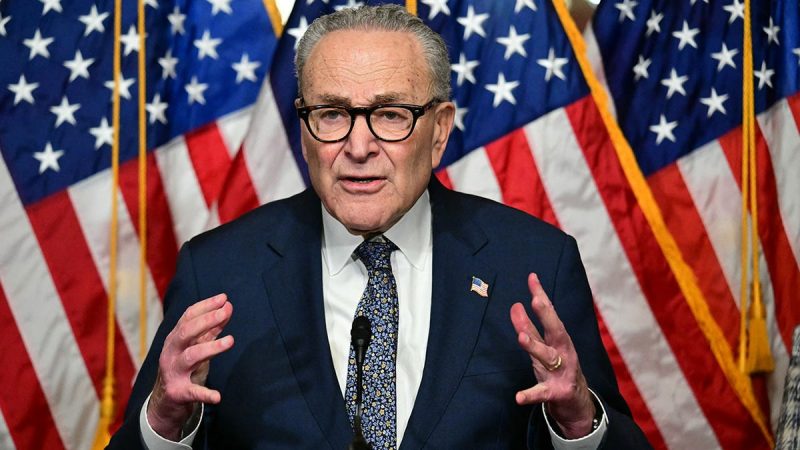
Senate Democrats are riding high after a wave of victories on Election Day and view Democratic candidates’ performances as an indicator that their shutdown strategy is working.
As the government shutdown officially entered record-breaking territory in its 36th day, Senate Democrats felt emboldened by the election results, and saw the blowout wins across the country as an indictment against President Donald Trump and Republicans, particularly on the matter of expiring Obamacare premium subsidies.
Still, some Senate Democrats are mulling an off-ramp from the shutdown and considering an offer from Republicans that would guarantee them a vote on the expiring subsidies in exchange for supporting the House-passed continuing resolution (CR).
But some warn that caving now for the promise of a vote would be the wrong move.
‘If they cave now and go forward with a meaningless vote, I think it will be a horrible policy decision, and I think politically, to the Democrats,’ Sen. Bernie Sanders, I-Vt., said. ‘And you know, they’re going to come into the 2026 election. Some of you may have heard the expression, when we fight, we win. You ever hear that? Well, when you cave, you lose.’
Some Republicans fear that the election may have caused Senate Democrats to dig deeper into their position and remain united in their shutdown game plan.
President Donald Trump, during a breakfast at the White House with the Senate GOP Wednesday morning, contended that the ‘shutdown was a big factor, negative for the Republicans,’ on election night.
‘I think the Democrats, you know, may feel emboldened by it, but I think that people are going to get past election results fairly quickly and start remembering that they’ve just unilaterally decided to shut down the government,’ Sen. Thom Tillis, R-N.C., told Fox News Digital. ‘So I think it could be maybe a weak bump, but at the end of the day, we’re going to get back to the reality that we’ve got to fund the government.’
Republicans are also not budging from their shutdown strategy as the closure drags on. Senate Majority Leader John Thune, R-S.D., offered Senate Democrats a vote on the expiring subsidies and wants to jump-start the government funding process by tying a small package of spending bills to the CR.
‘Can this be over now? Have the American people suffered enough or do the Democrats need more?’ Thune said on the Senate floor.
Despite his and the GOP’s offer, and Trump’s offer to meet with Senate Minority Leader Chuck Schumer, D-N.Y., and House Minority Leader Hakeem Jeffries, D-N.Y., after the shutdown ended on the expiring subsidies, Senate Democrats do want more.
‘Republicans shouldn’t ignore us anymore for their own good and the country’s good,’ Schumer said on the Senate floor. ‘So this morning, Leader Jeffries and I once again demanded a meeting with the president. It’s time to sit down and negotiate with Democrats to bring this Republican shutdown to an end.’
Sen. Andy Kim, D-N.J., whose home state elected Gov.-elect Mikie Sherrill in a blowout double-digit win over Republican Jack Ciattarelli, contended that Trump ‘certainly feels weaker.’
‘This was a resounding defeat for Donald Trump,’ Kim said. ‘He should have woke up this morning and just immediately said, ‘I — we need to negotiate. We need to find an end to this shutdown.’’
And Sen. Ruben Gallego, D-Ariz., agreed with Sanders’ outlook that Democrats should dig in and not cave.
But whether it strengthened Senate Democrats’ hand in trying to get Trump to the negotiating table, he was skeptical.
‘If you’re dealing with rational actors, yes, are we dealing with rational actors? I have no idea,’ Gallego told Fox News Digital. ‘This is a man that’s going across the country and redistricting the hell out of the country, and amid this redistricting to help save him from potentially dealing with a Democratic-controlled Congress, and now he’s basically going to assure a Democratic Congress by screwing up the one thing that is entirely under his control, which is making sure these premiums don’t go up.’
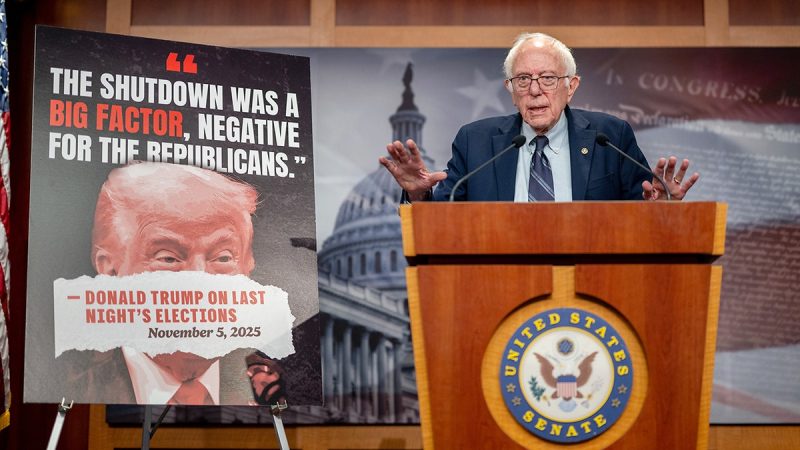
Sen. Bernie Sanders, I-Vt., took over Senate Minority Leader Chuck Schumer’s post-election news conference Wednesday, knocking the Democratic Party for their lack of support in political races in New York and Maine.
‘Well, the party leadership did not support [mayoral candidate Zohran] Mamdani in New York,’ Sanders said in front of the Senate podium. ‘Party leadership is not supporting [Senate hopeful Graham] Platner in Maine. And I think he’s going to win… I think there is a growing understanding that leadership, and defending the status quo and the inequalities that exist in America, is not where the American people are.’
Mamdani, a Democratic Socialist, won the mayoral race in New York City and Democrat Mikie Sherrill secured the New Jersey governorship.
California’s Proposition 50 was also passed after being placed on the ballot, and Democrats will maintain control of the Pennsylvania Supreme Court as Justices Christine Donohue, Kevin Dougherty and David Wecht won their respective retention races.
Prior to Sanders’ outburst, Schumer, D-N.Y., spoke with reporters, bashing Republicans as the government shutdown stretches into its 36th day, making it the longest shutdown in U.S. history.
‘Last night, Republicans felt the political repercussions [of the Trump administration’s policies],’ Schumer said. ‘It should serve as nothing short of a five-alarm fire to the Republicans. Their high-cost house is burning, and they’ve only got themselves to blame. As loudly and clearly as could possibly be done, from one end of the country to the other, the American people said enough is enough.’
Schumer said he and House Minority Leader Hakeem Jeffries demanded Wednesday morning President Donald Trump sit down with them to discuss healthcare issues.
‘Last night was a really good night for Democrats and our fight to lower costs, improve health care and reach a better future for our country,’ Schumer said. ‘But more importantly than that, last night was a great night for American families that are struggling now to make ends meet, because the election showed that Democrats’ control of the Senate is much closer than the people and the prognosticators realize. The more Republicans double down on raising costs and bowing down to Trump, the more their Senate majority is at risk.
‘… When Leader Jeffries and I met with Donald Trump in the White House a month or so back, we told him this was going to happen. We warned him that if he didn’t do something, working with us to address the health care needs of America, and instead insisting on no negotiation with Democrats, that was a recipe for disaster for the country, and it would come back to haunt them. Last night should make it clear to Republicans that they simply cannot continue to ignore not only us, but the American people, for the good of the whole country.’
Democratic leaders have been urging Republicans in both the House and Senate to confront the surge in health insurance premiums tied to the expiration of Affordable Care Act subsidies.
At the same time, funding for the Supplemental Nutrition Assistance Program (SNAP) has lapsed.
Though several stopgap measures have been proposed by Republicans, including a GOP-led bill blocked Tuesday, Congress has yet to reach an agreement.

Altech Batteries (ATC:AU) has announced Altech – Service Data Confirms Exceptional Failure Rate
Download the PDF here.